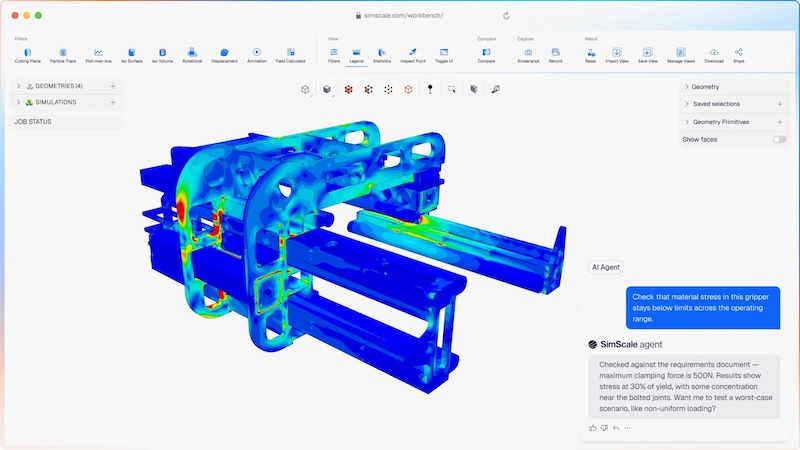
Dexory has deployed SimScale Engineering AI to accelerate the design, simulation, and testing workflows used to develop its autonomous warehouse robots.
The UK robotics company will apply the technology to structural failure investigation, automated parameter studies, simulation reporting, and the creation of a searchable record of engineering knowledge accumulated across previous projects.
Dexory already uses SimScale’s cloud simulation environment, while the new programme adds artificial intelligence agents capable of orchestrating parts of the workflow. Engineers can examine more design variations without preparing every individual simulation manually.
When a structural component fails, the planned root cause workflow will allow engineers to vary geometry, materials, loading, boundary conditions, and operating assumptions rather than relying on a narrow set of manually configured cases. The resulting combinations can then be compared with the observed problem.
Automated reporting should make results easier to compare and circulate between engineering teams, while parameter studies can test several variables in parallel. That approach gives designers a broader view of the available design space than a sequence of isolated calculations.
As the company expands, the system will retain simulation knowledge by capturing information from earlier studies and making it searchable. Useful assumptions, methods, and findings should then be less likely to remain buried in project folders or disappear when engineers change roles.
Calum MacDougall, senior mechanical design engineer at Dexory, said: “AI has a ‘blank sheet of paper’ problem in engineering because we’re still discovering where it can create the greatest value.
“This pilot isn’t just about solving today’s engineering challenges. It’s about understanding how AI will reshape engineering over the coming years and helping us discover where it can genuinely transform the way engineers work.”
Warehouse robots operate under repeated acceleration, braking, lifting, wheel impacts, uneven floors, payload variation, and long duty cycles. Those conditions can create fatigue and vibration problems that are difficult to reproduce through a single static load case.
Simulation allows engineers to examine those loads before committing to tooling or production changes, although conventional workflows require extensive preparation. Geometry must be cleaned, models meshed, materials assigned, constraints defined, solvers configured, results checked, and findings documented.
Artificial intelligence can remove repetitive work from that sequence, but engineering judgement remains necessary when deciding whether a model represents the physical system adequately. An automated study built on poor assumptions can produce a larger volume of misleading results.
The deployment follows a wider move towards flexible warehouse automation, including platforms designed to coordinate equipment from several suppliers. Work on software for mixed robot fleets reflects demand for systems that can expand without tying an operation to one machine type or control architecture.
Shorter development cycles must still deliver reliable equipment because warehouse installations are capital projects tied to defined throughput, availability, and return on investment. Mechanical failures after deployment can affect service commitments, maintenance costs, customer confidence, and the economics of the complete installation.
Although simulation can direct prototypes and test programmes towards the most important risks, physical testing remains indispensable, with fatigue rigs, environmental trials, instrumented machines, and field data still needed to confirm predicted behaviour.
Correlation between simulated and observed results will determine how much confidence engineers can place in later automated studies. The process also requires controlled material data, suitable loading assumptions, documented model revisions, and clear acceptance criteria.
Data governance becomes more important when simulation records are converted into reusable organisational knowledge. Companies must distinguish approved methods from exploratory work, identify the software and model version used, and preserve the assumptions behind each result.
As warehouse fleets accumulate operating hours, their loads, travel patterns, charging cycles, temperatures, impacts, and maintenance records can improve later design work. The data can reveal where development assumptions differ from service conditions, provided it is cleaned and linked to the correct machine configuration.
Dexory’s programme provides a practical test of artificial intelligence within the development of physical industrial equipment, where designs must withstand loads, tolerances, wear, and operating conditions rather than remain within a software environment.
The pilot will help determine which tasks can be automated and where direct engineering control remains necessary. Its value will be measured through fewer design iterations, faster investigations, stronger documentation, lower rework, and reliable machines in continuous service across demanding warehouse and logistics environments.