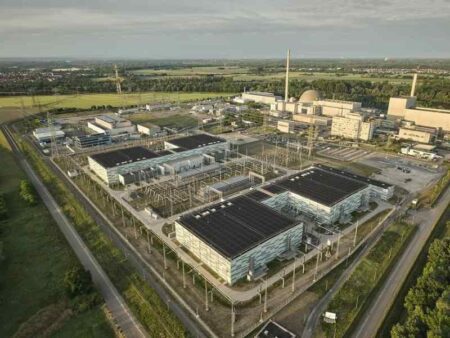

Philippsburg Energy Park. Image courtesy EnBW.
German energy company EnBW has announced a 400MW/800MWh battery energy project (BESS) at a former nuclear power plant site, feeding renewable power into the grid when it is needed.
The energy company has presented a project proposal for the large-scale battery storage facility at the Philippsburg power plant, where dismantling of two nuclear power plant units has been underway since 2017 and 2020.
The facility, which EnBW says will be one of Germany’s largest, will have enough output and capacity to correspond to the daily electricity demand of around 100,000 households.
The project would be the latest attempt to repurpose the plant and would be built adjacent to TSO TransnetBW’s large direct current substation. The substation converter, itself built adjacent to the energy park, forms part of the ULTRANET direct current link, which will make wind power from northern Germany available in the southwest of the country.
When there is a large amount of electricity available from renewable sources such as wind or solar power, the storage facility will absorb electricity from the grid. When the electricity is needed, it is fed back into the grid. According to EnBW, this would make Philippsburg a central hub and storage location for electricity from renewable energies in Germany.
Have you read:
TransnetBW and Octopus Energy successfully trial OctoFlexBW for EV to grid flexibility
EnBW and TransnetBW open power plant as grid stability tech
Peter Heydecker, Board member for Sustainable Generation Infrastructure at EnBW, explained in a release that large-scale BESS reconcile two aspects in the future energy system – weather-dependent generation capacity of renewables and the actual electricity demand of consumers, such as households, businesses, and industry.
“Together with hydrogen-capable gas-fired power plants, which are also designed for longer periods of operation, they provide the flexibility we need in the system,” said Heydecker.
Commented Philippsburg’s mayor Stefan Martus: “Philippsburg has been one of the most important energy locations in Germany for half a century – and our community should continue to play this outstanding role in the future: as an anchor point and huge storage facility for sustainable electricity generation.”
EnBW says the large-scale project will be realised without government funding.
Rather, in addition to the revenue from the marketing of the electricity volumes, the storage facility will be financed through the provision of grid-supporting services.
The company adds that, due to an existing grid connection and the existing local energy infrastructure, the site is ideally suited for the BESS. This continued use makes the battery storage project much easier to implement than would be the case if it were implemented at a completely new location.
TransnetBW is expected to provide the grid connection with the necessary capacity for storage and withdrawal by mid-2027.
Additionally, the availability of a building permit and a final investment decision is still pending for the project, which is still at an early stage.
If all goes well, says EnBW, implementation is conceivable by the end of 2027. The company adds that the construction site for the battery would be available in the energy park regardless of the dismantling of the nuclear power plant units.