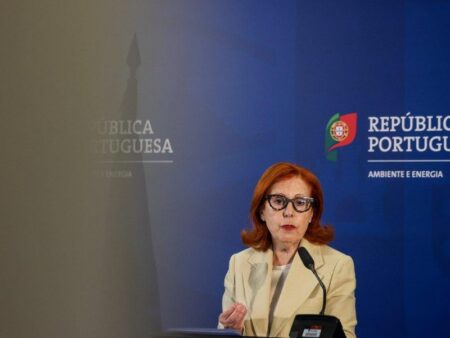

Portuguese minister for the Environment and Energy Maria da Graça Carvalho
The Portuguese government has announced a series of measures to strengthen the power system following the April 28 blackout that affected Portugal, Spain and parts of France.
Among the measures is €137 million ($158.5 million) aimed at bolstering the resilience of the power grid.
Portugal’s Environment and Energy minister Maria da Graça Carvalho said in a press conference that the set of measures aims to ensure the country and its power system is better prepared for emergency situations.
Specifically, the grid investment is divided into three technical components: two shunt reactors that will control the network’s voltage profiles; two STATCOMs that will provide automatic and instantaneous voltage control through reactive power regulation; and a synchronous compensator that also serves for automatic voltage regulation through rotating masses.
Additionally, Portugal’s government in a release states that, by January 2026, the following actions will be launched:
- An auction for a 750MVA battery-based storage system
- A €25 million ($28.9 million) tender will be launched to support improvements in the responsiveness of critical infrastructure
- Increased municipal compensation and mandatory community involvement and acceptance in renewable energy projects
- Creation of a ‘Green Map’ with pre-approved zones for renewable energy production, with a strategic environmental study, eliminating time-consuming authorisations
- A simplification of self-consumption projects and energy communities.
Additionally, as part of international collaboration, Portugal says they will work alongside Spain to prioritise interconnections – such as the one with Morocco that was crucial for restoration during the April blackout – with the rest of Europe within the EU for security of supply.
Carvalho added that this coordination is already having practical effects, such as the loan taken out by the Spanish Government from the EIB to accelerate interconnections with France.
The investment into the grid forms part of a wider investment from the Portuguese government totalling €400 million ($462.6 million) across three pillars: resilience of critical infrastructures, energy transition, and international cooperation.
Other measures announced include doubling the number of ‘black start’ power stations from two to four, adding the Baixo Sabor and Alqueva plants to those of Tapada do Outeiro and Castelo de Bode, as well as bolstering the resilience of critical infrastructure, such as hospitals and water and sanitation companies, with solar panels and batteries.
More on the blackout in Iberia:
Jolt to the system: What the Iberian blackout says about grid investment
Five seconds to failure: Iberia’s blackout and grid resilience in a high-renewables future
April blackout and grid resilience
The April blackout that hit the Iberian Peninsula, which is still under investigation by an Expert Panel from ENTSO-E with a final report due in October, highlighted the urgent need for more resilience measures in grid systems.
Two weeks ago, Europe’s TSO association released an update of their investigation, saying the blackout was of an “exceptional character”, demonstrating the need for improved measures against cascading voltage increases.
The Spanish government in June released a report on the causes of the April 28 Iberia blackout, saying the event was caused by a ‘multifactoral origin’ that caused a chain reaction of overvoltage disconnections.
The government claimed that Spain’s system operator, Red Eléctrica, shared responsibility due to voltage miscalculations; Red Eléctrica submitted its own report, attributing the causes to generation interruptions.
Both reports from Red Eléctrica and the Spanish government will be considered in ENTSO-E’s investigation, the European TSO Network says.