Tianjin Port orders battery electric tug

Tianjin Port orders battery electric tug

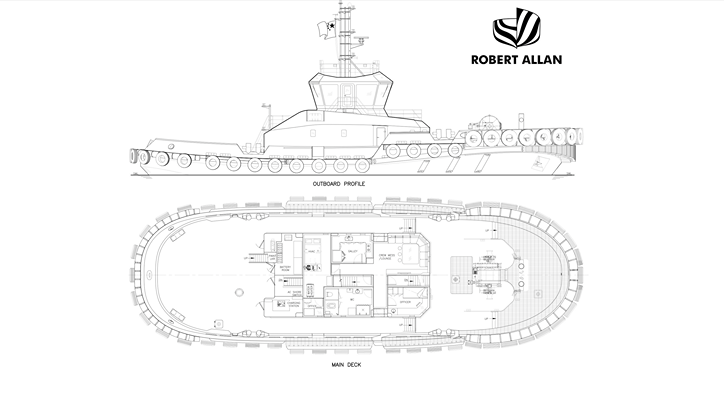
Robert Allan has been awarded a contract to design an AmpRA 3600 tug for Tianjin Port in northern China. The vessel will be 35.8m long, 11.2m wide and 5.2m deep. It will have a bollard pull of 62 tons and be able to accommodate seven people. Battery technology The tug will be powered solely by…


Robert Allan has been awarded a contract to design an AmpRA 3600 tug for Tianjin Port in northern China. The vessel will be 35.8m long, 11.2m wide and 5.2m deep. It will have a bollard pull of 62 tons and be able to accommodate seven people.

Battery technology

The tug will be powered solely by batteries, with no generator sets onboard, making it a fully battery electric and diesel-free ship-handling tug. It will also be the first Robert Allan Ltd battery electric vessel operating in China.

The main equipment will be supplied by Chinese manufacturers, including over 7MWh of batteries from CATL, the electrical system from the 704 Institute, and L-drives from Nanjing High Accurate Marine Equipment.

Partnership history

The AmpRA 3600 series tug will be constructed at Jiangsu Zhenjiang Shipyard (Group). According to Robert Allan, this agreement builds on a conventional propulsion design for the same owner and shipyard, with two vessels of similar hull form in service, but with a much greener propulsion system.
In related news, SAAM recently christened the first electric tugboat in Latin America. Trapananda reportedly has zero direct CO2 emissions and can reduce underwater noise to protect marine life and contribute to the decarbonization of the port sector


Stories for you


  • Polymer Comply backs European plastics campaign

    Polymer Comply backs European plastics campaign

    Polymer Comply Europe has backed a campaign for regional recycling. The move adds another industry voice to calls for stronger European plastics recovery and reuse capacity.


  • Data centres lag on AI power visibility

    Data centres lag on AI power visibility

    AI growth is exposing weak power visibility in data centres. New survey findings suggest many operators still lack the monitoring needed to scale dense compute loads safely.
