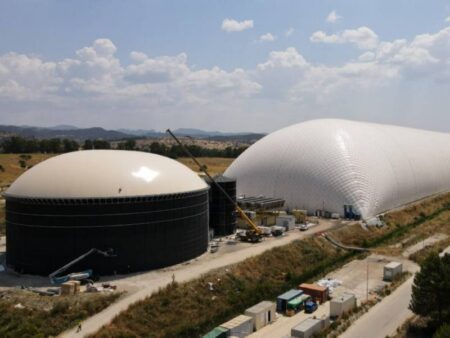

Energy Dome’s CO2 battery. Image courtesy Energy Dome
Google has partnered with Milan-based Energy Dome, adding their novel CO2 battery to their technology portfolio.
Through a commercial agreement, Google says they are planning to support multiple global projects by deploying Energy Dome’s long duration energy storage (LDES) technology.
The deal is Google’s first for commercial long-duration energy storage, joining a portfolio of advanced energy technologies needed to meet its goal to run operations on 24/7 carbon-free energy by 2030.
Energy Dome’s CO2 battery is capable of continuously dispatching energy for periods of 8 to 24 hours, unlocking enough firm electricity to meet both the baseload and flexibility requirements of large energy users, such as Google.
The CO2 battery technology uses a thermo-mechanical cycle, charging by drawing carbon dioxide from a ‘Dome’ gasholder, storing it under pressure, and then dispatching it by evaporating and expanding the gas through a turbine back into the gasholder.
The commercial agreement aims to develop CO2 battery projects in all of Google’s key geographical strategic areas, including Europe, America, and the Asia-Pacific region. A pipeline of sites and projects has been identified in the partnership, which are currently in development and contracting stages.
Have you read:
DTEK and Fluence battery project goes into commissioning
Red Eléctrica to construct batteries for Balearic transmission interconnection
Google cites the inflexibility of solar and wind technologies stemming from their intermittency, which can be resolved by LDES, which stores the energy and dispatches later when needed.
Furthermore, says Google, the mechanical components of the technology help stabilise the grid by providing natural inertia from rotating machinery.
This is especially important given the concurrent ramp-up of solar and wind (which lack inertia) with the ramp-down of legacy fossil-fuel power stations, whose inertia is lost when the plants are decommissioned.
The CO2 battery then contributes to maintaining grid resiliency by acting as a shock absorber to smooth out sudden changes in frequency.
Commenting in a release was Claudio Spadacini, founder and CEO of Energy Dome: “The programmatic and strategic deployment of our technology at scale to help Google reach carbon-free energy represents the core of our industry-first agreement.
“We’re proving that a 24/7 cost-effective and carbon-free energy supply is achievable with the right technology and partnership model. We are also pleased to welcome Google as an investor in Energy Dome, underlining our joint commitment to a shared vision.”
Beyond the commercial collaboration, Google has also made an investment in the scaleup. Financial details have not been disclosed.