In 2011, Sir Roy McNulty’s rail value for money study – Realising the potential of rail in Great Britain – concluded that GB rail cost £3 billion per annum more than it should and that a 30% reduction in cost per passenger-kilometre should be achievable.
It found that these high costs were due to the fragmentation and misaligned incentives. It also considered that “the history of innovation in the GB rail industry has often not been impressive” and recommended the creation of a leadership group to drive innovation which was felt could deliver 18% of the required savings.
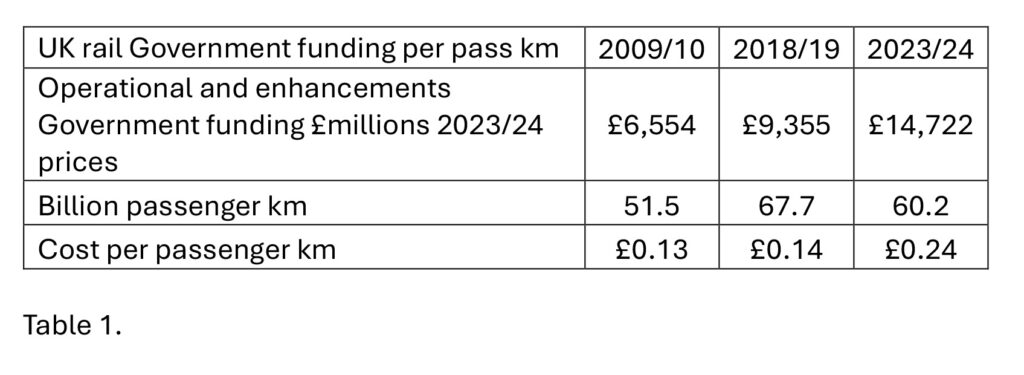
Unfortunately, as shown by table 1 (below), UK rail’s cost to the taxpayer per passenger-kilometre has increased by 92% since 2009/10. Though UK rail has failed to keep its costs down, many new technologies have been introduced since the McNulty report. Hence, this feature looks back to consider whether it is still the case that UK rail has an unimpressive innovation record.

RIA’s Innovation Conferences
RIA held its first Innovation Conference in 2009. This was a one-day seminar for around 50 delegates. At that time only 18% of the mobile phones sold in the UK were smartphones and innovation was rarely talked about within the rail industry.
Your writer attended his first RIA Innovation Conference, which welcomed 177 delegates, in 2013. Much of this conference explained the role of organisations that had recently been established to promote innovation. These included the Transport Strategy Board (TSB) in 2007; Rail Research UK Association – universities working in with industry (2011); and RSSB’s cross industry Enabling Innovation Team (2012).
In 2011, Network Rail launched its new approach to innovation which included challenge statements to advise the supply chain of the problems it faced. 2012 saw the launch of the Rail Technical Strategy as well as RIA’s Unlocking Innovation programme.
The TSB, which became Innovate UK in 2014, launched its first Accelerating Innovation in Rail competition in 2011. Another of its initiatives was Knowledge Transfer Partnerships to help businesses develop new products with the help of an expert academic adviser. Also, in 2013, the Department for Transport required new franchises to include R&D spend.
Thus, although the overall rail industry innovation leadership group that McNulty had proposed was not established, various organisations had been set up to promote innovation. However, potential innovators did not have a clear route to progress their ideas, though RIA did much to clarify the roles of these organisations.
RIA’s conferences have also showed the difficulties of implementing innovations. The 2017 conference revealed arguments about ownership of the data from the train-mounted energy harvesting sensors which could benefit both the train operator and Network Rail. In 2018, it was shown that train operators with short franchises cannot find a business case for DMU gearboxes offering 16% fuel savings.
These conferences always had thought-provoking keynote presentations. In 2017, it was explained how cloud computing and smartphones provide mobility as a service by integrating all Helsinki’s public transport. This significantly increased the use of public transport which is paid for by a monthly subscription. In 2018, a Siemens presentation showed how improvements in remote condition monitoring were the key to reducing cost of offshore wind power from £200 to £52 per MW/hr.
The 2025 conference
RIA recently held its sixteenth innovation conference in Newport, South Wales. The event was attended by almost 500 delegates and had 61 exhibition stalls. Away from the conference hall, there were exhibition spotlights at 19 of these stalls. At pitch sessions, innovators presented their ideas to innovation managers from train operating companies. A hackathon also offered the opportunity to showcase their digital innovations using data from the Rail Data Marketplace (RDM) to tackle defined industry challenges.
In the conference hall there were keynote presentations, ‘fireside’ chats, technical talks and panel discussions. As always it was a worthwhile thought-provoking event.
Promoting innovation
Many of the speakers were from organisations supporting innovation. Geoff Ogden, chief transport planning and development officer for Transport for Wales (TfW), explained his organisation’s innovation accelerator programme which, this year, will focus on revenue generation and cost efficiency, modal shift and engagement, as well as operational excellence. Dr Alan Peters of Connected Places Catapult (CPC) explained how CPC’s refreshed strategy applies effective procurement routes, fosters a culture of innovation, and promotes data sharing infrastructure and international collaboration.
Paul Corcoran of the Rail Supply Group (RSG) explained the purpose of the rail sector’s innovation charter which includes clear commitments related to procurement and bidding, supply chain collaboration, data sharing, and intellectual property ownership. He emphasised the importance of behaviours and advised that those in the industry should not wait until rail reform to change its behaviours.

Since 2017, Innovate UK has run seven First of a Kind (FOAK) competitions which awarded 128 companies innovation funding for specific themes. Klara Ludinova described the eighth FOAK completion in which organisations can apply for a share of up to £4.7 million across four themes of Platform Train Interface, Personal Safety, Bridge Strikes, and AI for complex processes. The successful companies have to develop a prototype, conduct field testing, and demonstrate their solution. Projects can last between three and seven months and must be completed by March 2026.
The UK Rail Research and Innovation Network (UKRRIN) was established in 2018 to create a collaboration between academia and industry, with centres of excellence in rolling stock, infrastructure, digital systems, and testing. In a panel discussion Professor Paul Plummer of the University of Birmingham (digital systems), Professor Paul Allen of the University of Huddersfield (rolling stock) and Rod Anderson from the University of Southampton (infrastructure) reflected on UKRRIN’s successes. Paul Allen made the point that the industry should make best use of UKRRIN’s high-cost facilities such as the rolling stock rigs at Huddersfield.
Simon Jones, the chief executive of the Global Centre for Rail Excellence (GCRE), described how GCRE had recently showcased 12 projects through a £7.4 million ‘Innovation in Railway Construction’ competition as described elsewhere in this issue.
As reported in Issue 210 (Sept-Oct 2024) GCRE has plans to construct two 7km loops on top of a Welsh hill, one to test rolling stock and one to test infrastructure. Seventy million pounds of Welsh and UK government funding has been used to establish this project. GCRE is now in discussions with a potential funder for the hundreds of millions needed to complete this facility which 200 companies across the international supply chain have expressed their desire to use.
Network Rail’s RD&I
Network Rail Chief Technology Officer Robert Ampomah described how Network Rail aims to use innovation to meet its key priorities of: cost efficiency, boots off ballast, use of data, and weather resilience. He advised that Network Rail wished to grow innovation partnerships and was committed to RSG’s innovation charter to attract and support SMEs.
On day two, Martin Taylor, Network Rail’s Wales and Western infrastructure director, told delegates that his region has £4 million available for research and development. He wished to see this used to create digitally enabled teams and encourage innovations that deliver the outcomes our customers desire. He illustrated his presentation with examples of innovations which included optimised earthing, the PodFlo possession safety critical communication app; climate adaptation pathways, and drones.
Network Rail’s ‘Unlocking RD&I’ workshop had presentations on funding, procurement, and partnerships. Head of Strategy James Heslop advised that Network Rail’s CP7 funding settlement included £146 million for RD&I from which it is expected that cross-industry collaboration will raise an additional £70 million of co-funding. He explained that good RD&I proposals must be aligned with the railway technical strategy, have a benefits case endorsed at route level, consider commercially off the shelf solutions and have a procurement case. He advised that Network Rail’s RD&I programmes typically offer a benefit cost ratio of 2.5 and rarely fail.

Sourcing Manager Adam Titmus explained the implications of the 2023 Procurement Act in respect of prototypes and development. He considered that this encouraged innovation and simplified the bidding process by, for example, auditing accounts after award. Head of Rail Technology Gareth Evans described how partnership funding potential is identified for each Network Rail challenge statement.
In addition to its UK funding partners such as Innovate UK, UKRRIN, and the Manufacturing Technology Centre, Network Rail has an International Research & Development partnership programme. This includes collaborations with ProRail (Netherlands), BaneNor (Norway), Trafikverket (Sweden), the Korean Rail Research Institute SBB (Switzerland), and Canada’s national railways.
Passengers and freight
Shamit Gaiger is managing director at the West Coast Partnership development which is to introduce HS2 services. She advised that customers were the heart of its decision making and how innovation was embedded into the company’s thinking. However, it is difficult to see how innovations can overcome the severe capacity constraints from the decision to cancel HS2 Phase 2a. Speaking to Rail Engineer after her presentation Shamit advised that there were plans to address this issue which will be revealed in due course.
LNER Managing Director David Horne, described its annual accelerator programme, FutureLabs, and the company’s recent innovations. These included seat sensors to identify unoccupied seats and at-seat QR codes for at-seat ordering. He advised that LNER was to remove Off-Peak fares and introduce a new non-refundable 70-minute flex fare that can be used within 70 minutes of the booked departure time.
From Avanti West Coast, Managing Director Andy Mellors stressed that the pandemic requires the industry to be more agile and that it is more important than ever to work together. In this respect he mentioned Avanti’s Superfare tickets for which customers are given 24-hour’s notice of their train having booked a morning, afternoon, or evening departure slot, 56 to seven days beforehand. Avanti is also collaborating with RSSB on a social value programme which had an impact of £212 million per year by initiatives such as its Feel Good Field Trips programme that 8,000 children have so far experienced.
Richard Thorp is chief operating officer of London St Pancras High Speed, formerly HS1. His presentation explained that although there is a huge demand for international rail travel, St Pancras station is currently a huge constraint. Furthermore, as the HS1 route is now over 15 years old, renewal volumes are increasing exponentially. Hence the company’s challenges for its CP4 are automated inspections, predictive maintenance, optimised planning, and better use of data. He considered that as it is difficult to change how people work, it is important to think beyond the technology to the people who will be using it.
RIA also launched its report ‘The Journey to Equality: creating a railway for all’ which showed what needs to be done to improve accessibility across the railway network. This highlights the challenges faced by disabled people for which readily available solutions are available.
While the modern passenger train has the latest electrical control systems, a freight wagon has no electricity supply at all which makes it difficult to innovate. As reported in Issue 206 (Jan-Feb 2024), the iWagon has an electric supply that enables wagons to have wheel slide protection and provide real-time event data. Sanjay Albert, Knorr-Bremse’s director of engineering and innovation advised that 31 wagons are about to be certified for unrestricted use and that over 1,000 wagons have been targeted for retrofitting.

battery powered impact
wrench on Unipart stand. Credit: David Shirres

wearable positioning
alarm. Credit: David Shirres
Innovations on show
The 61 stands at the conference showcased numerous innovations. What follows is a necessarily small selection of these new technologies some of which related to conference presentations. For example, the Knorr-Bremse stand had a model iWagon, Arcadis were demonstrating its Enterprise Decision Analytics which help manage asset decisions, and Telent showed how AI has enhanced automated incident reports from its station management system.
The Transmission Dynamics stand explained how its train-mounted PANDA-V pantograph and overhead line monitoring system can now interact with the Intelligent Pantograph Network to prevent dewirements. It does so by instructing trains to drop their pantographs when approaching significant OLE faults found by a PANDA-V.
Other train mounted infrastructure monitoring systems included those from CrossTech and OneBigCircle. Fugro also has a train-mounted gauging system.
For those working on track, Unipart offered lightweight battery powered hand tools designed to minimise hand-arm vibration while PodFlo, which is now in use on Network Rail’s Wales & Western region, offers possession management for the digital age to ensure everyone has access to critical information in real time.
Also keeping track workers safe is Tended’s geofencing technology which warns workers if they leave their safe zone. This uses Real Time Kinematics GPS technology which is accurate to centimetres as it is related to the known location of a fixed base station. This system can also be used to monitor the position and speed of vehicles on site.
Another safety related system on display was the COMET incident investigation system which includes human factors analysis to ensure root causes are identified and lessons learnt from them.

Introducing GBRX
One of the most significant announcements at the innovation conference came from Toufic Machnouk, managing director of GBRX, which has been created to deliver one of the core missions of Great British Railways (GBR): driving strategic innovation across track and train and improving how the railway works for people.
In his presentation, Machnouk outlined GBRX’s role in confronting long-standing barriers to technological progress within the rail sector. He emphasised that innovation must be understood not simply as creativity, but as a structured process to solve problems and deliver meaningful improvement.
While the railway has adopted a range of technical innovations over time, Machnouk highlighted that many of its fundamental systems, from mechanical signalling to planning processes, route-wide data management, and energy use, have seen little transformational change.
He identified two critical blockers to innovation:
- The complexity of changing working practices within a highly regulated environment.
- The challenge of evolving a vast, tightly engineered industrial asset base across a fragmented commercial structure.
To address these systemic barriers, GBRX is establishing a Portfolio Board to align and oversee innovation resources across the sector. It will also launch an Innovation Platform to give potential suppliers and partners a structured route into the railway system, providing clearer pathways for ideas to be developed, tested, and adopted at scale.
Implementing innovation
As always, the RIA Innovation Conference was thought provoking with many worthwhile innovations on display. However, it is difficult to assess what is new each year, so it is perhaps more meaningful to consider the innovations introduced since the first RIA Innovation Conference in 2009, as shown in Table 2 (below).
Previous conferences have shown that some of the barriers to innovation that McNulty identified in 2011 have been eased. For example, there has been a significant increase in the use of passenger trains for infrastructure monitoring while, in 2017 there were arguments about who owned the data from such monitoring.

Furthermore, the demise of short passenger train franchises should remove barriers to investment in kit such as gearboxes offering a 20% reduction in fuel consumption, but whether there is sufficient government finance for such profitable investment is questionable. Indeed, it is this, rather than innovation technology, that has been the barrier to the removal of mechanical signalling that Machnouk mentioned in his GBRX presentation, as well as other profitable investments such as rail electrification.
Rail Minister, Lord Peter Hendy’s shares McNulty’s view that the railway has been held back by the slow adoption of innovations. However, as Table 2 shows, since 2009 there have been some impressive innovations. For example, new trains have a quantum leap in technical capabilities and much has been done to automate infrastructure monitoring.
To advise the supply chain of the problems it faced, Network Rail first issued challenge statements in 2011. It spends around £50 million per annum on its RD&I programme which has an estimated return of £3 for every £1 spent and includes many worldwide innovation partnerships. This would seem to be the approach that GBRX is to adopt for the whole industry, in particular the track train-interface which presents particular problems as the implementation of ETCS has shown.
As we reported in Issue 201 (Mar-April 2023), an ORR report on Network Rail’s introduction of new technology shows Machnouk is right to emphasise that innovation is a process as this report showed that incorporating new technology into existing processes was a significant barrier. Furthermore, there is a need to update planning processes. At the 2017 conference concern was expressed that it would probably take Network Rail six months to advise what is needed to increase the weight of a freight train from 2,000 to 2,600 tonnes. This issue’s rail freight feature indicates that there has been some progress in this respect.
The above indicates that much good use is being made of the latest technologies. Yet, as McNulty recommended 14 years ago, a strategic body is needed to drive innovation across the industry as a whole and co-ordinate the work of existing rail innovation bodies.
It is good to see that, as part of the implementation of GBR, the establishment of GBRX belatedly implements this 2011 recommendation. Rail Engineer wishes GBRX well and looks forward to reporting how it will drive innovation across the whole industry.
Image credit: Voith