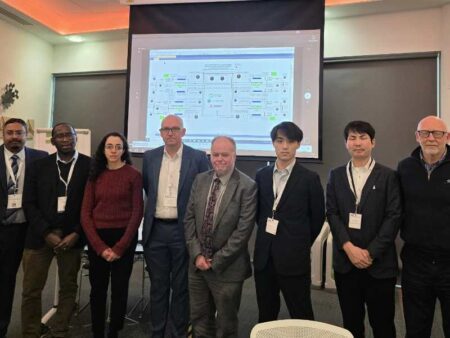

From left to right: Nithiananthan Vejayan (SSENT Innovation team lead), Dumisani Simfukwe (SSENT HVDC engineering lead), Fainan Hassan (GE Vernova), Carl Barker (GE Vernova) Ben Marshall (National HVDC Centre), Yamato Kentaro (Mitsubishi Electric), Yohei Okada (Mitsubishi Electric, Steve Langdon (Mitsubishi Electric). Image courtesy SSEN transmission
In what they call a world-first, SSEN Transmission has successfully demonstrated its Aquila Lite project, a software interface that allows for HVDC multi-vendor interoperability.
According to the utility in a release, the interface allows different manufacturers’ systems, such as controls and main circuits, to work together, eliminating the need for costly AC/DC conversion when transferring power between them.
The project, led by SSEN Transmission and supported through Ofgem’s Network Innovation Allowance (NIA), marks a significant breakthrough in realising the potential of the offshore HVDC grid network to deliver vast amounts of renewable energy to meet national clean energy and energy security ambitions.
As well as reducing capital investment costs associated with the construction of converter stations required to switch power between different systems, the technology reduces risk in the supply chain by avoiding reliance on a single supplier. Without interoperability, relying on a sole manufacturer (or vendor) to provide the bulk of the technology required for the developing offshore HVDC grid could expose future network operations to outage risks.
It has led to the development and patenting of a cutting-edge multi-terminal, multi-vendor HVDC control approach developed by The National HVDC Centre, which is owned and operated by SSEN Transmission in partnership with other transmission operators and the National Energy System Operator.
Have you read:
National Grid awards £46bn HVDC supply chain framework contracts
Samsung C&T enters HVDC market with Hitachi Energy partnership
Nithiananthan Vejayan, Innovation Delivery project manager at SSEN Transmission, said: “We’re delighted to have achieved this historic milestone in our Aquila Lite innovation project, which has demonstrated how different vendor devices can harmoniously connect to a DC network and operate collectively to meet the requirements of Transmission Owners and operators.
“The achievement of multi-vendor interoperability in HVDC technology signals a new era in sustainable energy innovation and underscores SSEN Transmission’s commitment to driving transformative change in the electricity sector to deliver a network for net zero.
“We plan further demonstrations with both Hitachi Energy and Siemens Energy ahead of the completion of the project, and continue to actively work with all vendors to demonstrate collective interoperability.”
Ben Marshall, HVDC technology manager at The National HVDC Centre, said: “The results of our demonstration have instilled industry confidence that interoperability is not just theoretical but practical and can be commercially, legally, and technically managed across the delivery of real projects.
“By patenting our process, we have removed any barriers to implementing this approach, setting the stage for future deployments with multiple Transmission System Operator projects in the early 2030s.”
The Aquila Lite project was first demonstrated in collaboration with principal contractors GE Vernova and Mitsubishi at the recent IET ACDC International Conference, the first of several intended demonstrations across vendors.