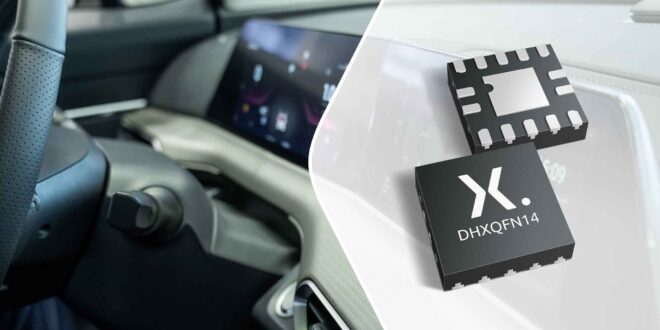

Nexperia has released a new family of next-generation fixed-direction voltage level translators for use with some of the most commonly used push-pull data interfaces (including UART, SPI and JTAG protocols) as well as for general purpose input/output (GPIO).
The NXU series of 4-bit, 2-bit, and 1-bit dual-supply buffers offer a smaller, higher performance and lower-cost level translation solution that simplifies communication between a host processor and peripheral I/O devices compared to existing designs in a broad range of consumer, industrial, automotive and enterprise applications.
Existing direction-controlled level translators typically require an additional GPIO pin for direction control, a requirement which increases device size while also adding to design complexity because it consumes I/O resources of the host processor. On the other hand, while auto-direction devices do not require a GPIO pin for direction control, they typically cannot provide the level of current drive required by many applications.
Furthermore, they can sometimes exhibit non-deterministic I/O behaviour resulting from one-shot architectures that can be time-consuming to debug. Another shortcoming of direction-controlled and auto-direction devices is that they typically consume too much power for power sensitive implementations.
Devices in Nexperia’s NXU family have been designed to combine the parametric performance capabilities of direction-controlled translation devices (i.e., high data rate, high drive strength, and glitch free power sequencing) with the lower pin-out and size advantages of auto-direction devices. The NXU translator devices consume significantly less power (>2x reduction) compared to auto-direction devices (for comparable bit counts). They also have a wider supply voltage range (0.9V to 5.5V) making the devices suitable for translating between any of the voltage nodes from 0.9V up to 5V. The NXU devices also support faster data rates (up to 250 Mbps) than other voltage translation solutions.
The NXU family of translators complements Nexperia’s existing portfolios of direction-controlled and auto-direction families of level translation devices by providing level translation solutions for applications that require a combination of auto-direction and direction-controlled capabilities.
For maximum flexibility, various data-direction and package configurations are provided, while automotive-qualified (AEC-Q100) variants are also available in packages with side-wettable flanks to enable automated optical inspection.