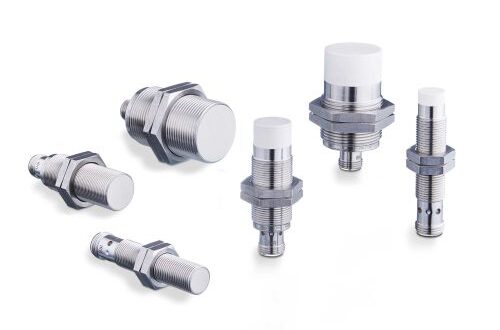

With the new PIProx range of inductive distance sensors from ifm electronic, reliably measuring the distance to metallic targets with micrometre precision no longer requires expensive measuring systems. PIProx sensors, which have familiar cylindrical bodies similar to those of conventional inductive proximity sensors, are easy to install, easy to set up, and, thanks to their IO-Link communication, easy to interface with almost any type of control system.
PIProx sensors are factory calibrated and ready to use out of the box. They can be relied on to deliver accurate, repeatable results, continuously outputting distance-to-target data via IO-Link. When the highest precision is required, simple one-point calibration, or even more accurate three-point calibration is possible. In all cases, the results are completely unaffected by the type of target metal.
To ensure suitability for the widest possible range of applications, PIProx sensors have an IP69K ingress protection rating and an operating temperature range of -25 to +70ºC. They are available in flush and non-flush mounting versions with 60 mm long industry standard M12, M18 and M30 threaded stainless-steel housings. All types are resistant to the effects of external magnetic fields, and all incorporate four LEDs for local status indication.
The measuring range of ifm’s PIProx inductive distance sensors depends on the model, with flush-mount M12 versions, for example, having a range of 0.2 to 2mm and non-flush M30 types having a range of 1.5 to 15mm. All types use IO-Link COM2 transmission mode and have a minimum process cycle time of 3.2ms.